
Introduction
This is a small PowerShell project that RC4 encrypts a file, base64 encodes the result, and can optionally pass the base64 through a swapped alphabet on the way out. If you run it in reverse with the same key you get the original file back. The RC4 function comes from Remko Weijnen and the alphabet translation from Doug Finke’s PowerShellTranslate, both used with permission.
It’s simple, and it does what the name says. I am writing about it as a Red Team piece for two reasons, and neither of them is that you should reach for it on an engagement.
RC4 plus base64 plus PowerShell is the canonical shape of a loader, so a benign implementation makes a clean specimen for discussing why that shape gets caught. It is also a tidy example of the difference between obfuscation and encryption, which matters more on the offensive side than people new to it tend to assume.
Defender quarantines it on sight
Before reaching any of the cryptography, the interesting behavior appeared on the first run. On an up to date Windows 10 computer with Microsoft Defender at its defaults, the script would not execute.
& : Operation did not complete successfully because the file
    contains a virus or potentially unwanted software.
The detection was not generic.
Threat   : TrojanDropper:PowerShell/Cobacis.B
Resource : ...\rc4-b64.ps1
To run it at all I had to add an exclusion for the directory, which I was not expecting to need for a teaching example.
An educational script, openly credited to two named authors, trips a Cobalt Strike adjacent dropper signature. That’s not a false positive in the usual sense. Defender is matching the structure of the code, and the structure of the code is genuinely the structure of a stager: a byte array key, a 256 iteration key schedule, an XOR keystream loop, and base64 on the output. Nothing about the signature cares that the intent here is a demonstration.
As far as detection is concerned, the pattern is the payload.
What it does
With the exclusion in place it runs normally. The screenshot below shows it against a file containing the word test, walked through every stage.
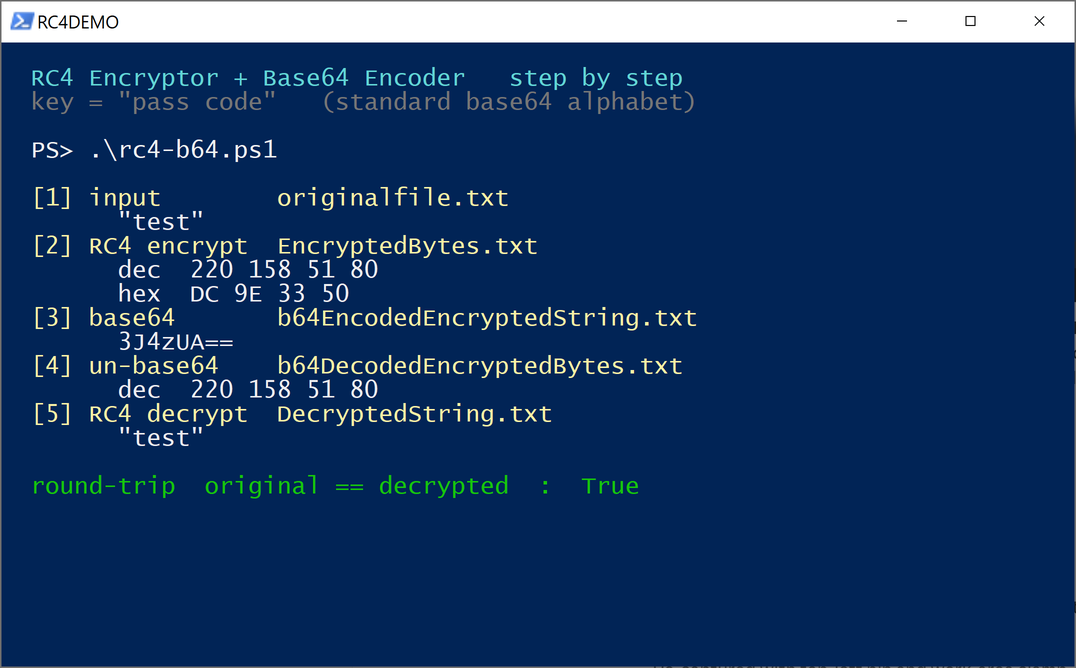
The pipeline is:
- Read the file into a byte array.
- RC4 encrypt it with a key, hardcoded in the script as the string
pass code. - Base64 encode the encrypted bytes.
- Optionally run the base64 text through a substitution that swaps the standard alphabet for a reordered one.
Each stage is written to its own file on disk, so you can inspect the whole transformation byte by byte.
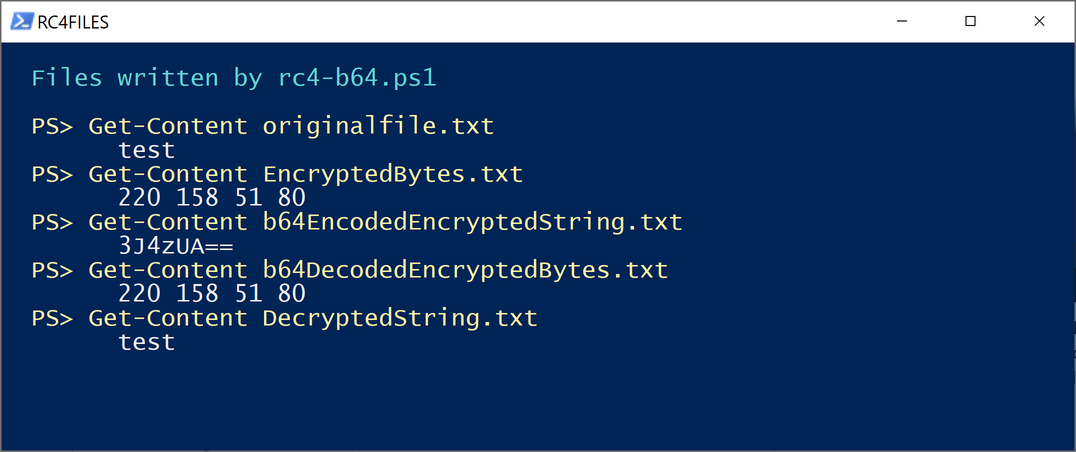
The RC4 itself is textbook. A key schedule permutes a 256 byte state array, then the generator walks that state producing a keystream that is XORed against the data.
$i = $j = 0
for ($x = 0; $x -lt $buffer.Length; $x++) {
    $i = ($i + 1) % 256
    $j = ($j + $s[$i]) % 256
    $temp = $s[$i]; $s[$i] = $s[$j]; $s[$j] = $temp
    [int]$t = ($s[$i] + $s[$j]) % 256
    $buffer[$x] = $buffer[$x] -bxor $s[$t]
}
The optional alphabet swap maps A-Za-z0-9+/ onto a reordered version of itself. If you enable it for the same input you get T9UPk0== instead of 3J4zUA==. The underlying ciphertext bytes are identical. All that changed is which base64 characters represent them.
Obfuscation is not encryption
It’s easy to look at “RC4 encrypted and base64 encoded with a custom alphabet” and read it as three layers of protection. It is one layer, and a weak one, wrapped in two layers of reversible encoding.
The custom alphabet adds nothing. A one to one remapping of the base64 characters is a monoalphabetic substitution. There’s no key. Anyone who notices that the output is base64 shaped can recover the standard alphabet by frequency or by trying the obvious mappings, and the substitution table is in plaintext in the script in any case.
Base64 is not encryption. It’s an encoding, reversible by definition and by design. That’s obvious when you state it plainly, and it remains one of the most commonly mislabelled things in the field.
The RC4 layer is the only cryptography here, and it is used in the weakest possible way. Two problems compound.
The key is hardcoded, so every copy of the script encrypts with the string pass code. The key is not secret from anyone who has the script, which includes anyone you sent an encrypted file to.
The key is also fixed with no IV or nonce, so every file is encrypted under the identical keystream. RC4 is a stream cipher, and reusing a keystream across two messages is the many time pad failure. It is catastrophic rather than gradual. If you XOR two ciphertexts together the keystream cancels out, leaving the XOR of the two plaintexts. Recover or guess one and you have the other. I confirmed this against the script’s own construction.
C1 xor C2 == P1 xor P2      : True
given P1 = "ATTACK AT DAWN"
recovered P2                : RETREAT NOW!!!
No key was needed to recover the second message. That is not an implementation bug in this script specifically. It’s what happens to any stream cipher used with a static key and no per message randomness.
RC4 on top of that is retired. It was prohibited in TLS by RFC 7465 in 2015 over its keystream biases, the same statistical leaks that made the early WEP attacks work. It should not be carrying anything you need kept secret in 2026.
None of this makes the script bad at what it is, which is a demonstration. It makes it a good illustration of a trap: layering reversible encodings around one weak cipher and mistaking the total for strength.
Detection
The useful question is not how to catch this exact script, which Defender already does by name. It is how to catch the pattern once the constants have been changed and the signature no longer matches.
AMSI is doing the real work here. Since PowerShell 4, script content is handed to the Antimalware Scan Interface at runtime, after any encoding or wrapping has been unwound in memory, and Defender’s Cobacis family matches the RC4 loop structure there. That’s why renaming the file or reshuffling the base64 alphabet would not help an attacker, because AMSI sees the deobfuscated body rather than the file on disk. You should confirm that AMSI is enabled and unbypassed on your endpoints, because a working AMSI bypass turns this from blocked on sight into runs silently.
Script block logging is the durable telemetry. PowerShell event ID 4104 records the deobfuscated content of what actually ran. If you enable it by policy and ship it to your SIEM, it survives the obfuscation for the same reason AMSI does.
The behavioral shape is signature independent. If you are writing a hunt rule, key it on what the technique structurally has to do, none of which depends on the specific bytes.
- byte array manipulation with a 256 element state array and modulo 256 arithmetic, the fingerprint of a hand rolled cipher in a script
- base64 encode or decode calls sitting next to XOR loops
- reading a file, transforming it, and writing an encoded blob back to disk
Do not treat execution policy as a control. The project’s own instructions tell you to run Set-ExecutionPolicy Unrestricted, which is a fair thing for a demonstration to ask and also a clear illustration of why execution policy is not a security boundary. It is a guardrail against accidental double clicks and it is trivially sidestepped with a flag. Watching for changes to it is more useful than relying on it.
The theme is the same one from the Morse packet transceiver post. Detections pinned to a tool’s specific constants are inexpensive to write and inexpensive to evade, while detections built on what a technique structurally has to do are harder to write and much harder to work around. Here an attacker cannot remove the RC4 loop or the base64 without giving up the result the tool exists to produce, and AMSI and script block logging both see through the wrapping.
Repository
The project is catalogued in the Red Team Projects repository along with the detection guidance above and the credits to Remko Weijnen and Doug Finke. The entry there is documentation only. I see no reason to publish another copy of a script that Defender quarantines on sight, and the analysis is the portion with any value.
The project itself is licensed under the GPL version 3. That version is deliberate rather than incidental. PowerShellTranslate is Apache 2.0, which the Free Software Foundation treats as incompatible with GPL version 2 but compatible with version 3, so version 2 would leave the project unable to lawfully include the code it is built on.
RC4 and the reversible encodings shown here provide no meaningful confidentiality. Do not use them to protect anything that needs protecting.